Beginning PC gaming in 2026 offers an incredibly rich and diverse experience for newcomers and veterans alike. This comprehensive guide helps aspiring gamers navigate the initial setup choosing the right hardware understanding software essentials and optimizing game performance. We cover everything from selecting a budget-friendly starter PC to advanced settings optimization ensuring a smooth entry into popular genres like FPS MOBA and RPG. Discover essential tips for managing ping resolving FPS drop issues and fixing stuttering for an uninterrupted gaming journey. Learn about crucial drivers and accessories like gaming mouse and mechanical keyboard that enhance gameplay and overall enjoyment. This resource is designed to empower every beginner with the knowledge needed to thrive in the exciting world of PC gaming.
how to begin pc gaming FAQ 2026 - 50+ Most Asked Questions Answered (Tips, Trick, Guide, How to, Bugs, Builds, Endgame)Welcome to the ultimate living FAQ for how to begin PC gaming in 2026! This comprehensive guide is designed to answer all your burning questions, from initial setup to optimizing advanced settings. With new hardware, software updates, and gaming trends emerging constantly, staying informed is key. We've compiled over 50 of the most asked questions, covering everything from essential builds and elusive bugs to winning strategies and endgame tips. Whether you're a complete beginner or looking to refine your casual play, this resource, updated for the latest patches and technology, will help you navigate the thrilling world of PC gaming with confidence and precision.
Beginner Questions & First Steps
What is the absolute minimum I need to start PC gaming in 2026?
To begin PC gaming in 2026, you minimally need a functioning computer with a dedicated graphics card (even an entry-level one), a monitor, keyboard, and mouse. An internet connection is crucial for most games. Many older or indie titles run well on more modest hardware. Start with what you have or acquire basic components.
How much does a decent beginner gaming PC cost in 2026?
A decent beginner gaming PC in 2026 typically costs between $700 and $1200 USD for a pre-built system. Building your own can save you a couple of hundred dollars. This budget allows for a system capable of running most modern games at 1080p with medium-to-high settings, providing a solid entry point. Prices fluctuate with component availability.
Should I build my own PC or buy a pre-built one as a beginner?
As a beginner, buying a pre-built PC is generally recommended. It offers convenience, warranties, and ensures component compatibility, reducing initial setup stress. Building your own offers cost savings and customization but requires research and patience. Start with a pre-built to jump into gaming faster, then consider building your next rig.
What are the most essential peripherals for a new PC gamer?
The most essential peripherals for a new PC gamer include a comfortable gaming mouse with adjustable DPI and a responsive mechanical keyboard for precise inputs. A high-refresh-rate monitor (144Hz+) significantly enhances visual fluidity. Don't forget a good quality headset for clear audio and communication, which is vital for multiplayer games.
Hardware & Builds
What CPU and GPU combo is recommended for 1080p gaming in 2026?
For solid 1080p gaming in 2026, a great combo is an Intel Core i5 15th Gen or AMD Ryzen 5 9000 series CPU paired with an NVIDIA RTX 5060 or AMD RX 8700 GPU. This setup provides excellent frame rates in most modern titles at high settings, offering a balanced performance for value. It's a sweet spot for many gamers.
How much RAM do I really need for gaming in 2026?
For most gaming in 2026, 16GB of DDR5 RAM is the sweet spot. While some games can use more, 16GB ensures smooth performance and multitasking without breaking the bank. If you plan on streaming or heavy content creation, 32GB might be beneficial, but it's not strictly necessary for just gaming.
Myth vs Reality: Is a more expensive power supply always better?
Myth: A more expensive power supply isn't always "better" if its wattage vastly exceeds your needs. Reality: You need a reliable PSU with sufficient wattage for your components and a good efficiency rating (e.g., Gold or Platinum). Overspending on excessive wattage is unnecessary; focus on quality and appropriate capacity for stability and longevity.
Settings Optimization & Performance
How can I optimize my game settings for the best FPS (frames per second)?
To optimize game settings for the best FPS, lower graphically intensive options first, such as shadows, anti-aliasing, and global illumination. Reduce texture quality if VRAM is an issue. Ensure your display resolution matches your monitor's native setting. Experiment incrementally to find the balance between visuals and frame rate. Update your graphics drivers regularly.
What causes FPS drop and stuttering fix tips?
FPS drops and stuttering are often caused by outdated drivers, overheating components, or background applications consuming resources. To fix, update graphics drivers, monitor CPU/GPU temperatures, close unnecessary programs, and verify game file integrity. Sometimes, a clean reinstallation of graphics drivers using DDU can resolve persistent issues effectively. Proper settings optimization also helps.
Myth vs Reality: Does lowering resolution always give the biggest FPS boost?
Myth: Lowering resolution always gives the biggest FPS boost. Reality: While lowering resolution *can* boost FPS, it often drastically degrades image quality. More impactful and visually subtle changes come from reducing settings like shadows, anti-aliasing, and global illumination. Try those first to maintain visual fidelity before dropping resolution for maximum FPS gains.
Connectivity & Lag Solutions
How do I reduce high ping and lag in online games effectively?
To effectively reduce high ping and lag, always use a wired Ethernet connection instead of Wi-Fi. Close all unnecessary background applications and browser tabs that consume bandwidth. Ensure your internet connection meets gaming demands and that your router firmware is updated. Running a quick speed test can confirm your baseline. This minimizes latency.
Myth vs Reality: Does a VPN always improve gaming ping?
Myth: A VPN always improves gaming ping. Reality: VPNs *rarely* improve ping. They route your connection through an additional server, usually increasing latency. They can help bypass geographical restrictions or ISP throttling, but for general ping reduction, a direct, wired connection is always superior. Use a VPN only if absolutely necessary for specific connectivity issues.
Drivers & System Maintenance
Why are graphics drivers so important and how often should I update them?
Graphics drivers are critical because they allow your operating system and games to communicate efficiently with your GPU. Outdated drivers can lead to performance issues, bugs, and crashes. You should check for and update them regularly, typically monthly or whenever a new game releases that benefits from specific driver optimizations. Always download directly from NVIDIA or AMD.
What are the best practices for keeping my PC clean physically?
For physical PC cleanliness, regularly dust the interior of your case, fans, and heatsinks (every 3-6 months) using compressed air. Ensure your PC is off and unplugged. Hold fan blades gently to prevent over-spinning. This prevents dust buildup which can cause overheating and reduce component lifespan, maintaining optimal airflow and performance.
Game Genres & Communities
What are some popular PC game genres for beginners to explore in 2026?
Popular PC game genres for beginners in 2026 include accessible FPS titles like Valorant, engaging RPGs such as Baldur's Gate 3, and strategic MOBA games like League of Legends. Indie games offer unique experiences, while Battle Royale games like Apex Legends remain popular. Exploring diverse genres helps you discover your preferred playstyle and community.
Myth vs Reality: Is PC gaming only for "hardcore" players?
Myth: PC gaming is only for "hardcore" players. Reality: PC gaming offers an incredibly diverse spectrum for every player type, from casual to competitive. There are countless accessible indie games, cozy simulation titles, and single-player narrative experiences that don't demand intense skill. The vast game library caters to all preferences and commitment levels, not just the "hardcore."
Advanced & Pro Tips
How can I start learning advanced strategies for competitive games?
To learn advanced competitive strategies, watch professional players on platforms like Twitch and YouTube. Analyze their decision-making, positioning, and item builds. Join game-specific Discord servers to discuss tactics with experienced players. Practice consistently, focusing on specific skills in training modes. Review your own gameplay recordings (VODs) to identify and correct mistakes. Deliberate practice is key.
Myth vs Reality: Do expensive gaming chairs really improve performance?
Myth: Expensive gaming chairs directly improve in-game performance. Reality: While a good gaming chair doesn't magically boost your FPS, it significantly improves comfort and ergonomics during long sessions. This reduces fatigue and discomfort, allowing for better focus and longer periods of play. Indirectly, improved comfort can contribute to sustained performance, but it's not a direct buff.
Troubleshooting & Fixes
What should I do if my game keeps crashing to desktop?
If your game keeps crashing, first ensure your graphics drivers are updated. Verify the integrity of game files through your game launcher (Steam, Epic Games). Check for overheating components with monitoring software. Try running the game in compatibility mode or as administrator. If issues persist, consider a clean reinstallation of the game or specific drivers. Crashes often point to driver conflicts or file corruption.
My sound isn't working in-game, but it works everywhere else. What's wrong?
If in-game sound isn't working, but system audio is fine, first check the in-game audio settings for correct output device selection and volume levels. Ensure your default Windows audio device is correctly set. Update your audio drivers from your motherboard manufacturer's website. Sometimes, third-party software or overlays can interfere; try disabling them temporarily. Restarting the game or PC often resolves minor glitches.
Endgame & Future-Proofing
How often should I upgrade my PC components for optimal performance?
For optimal performance, a typical PC gamer might upgrade their graphics card every 2-4 years, and their CPU every 4-6 years. RAM and storage upgrades are often more flexible, done as needed for capacity or speed. This staggered approach balances cost with keeping up with game demands, ensuring you don't overspend or fall too far behind. Monitor game requirements to guide decisions.
What are the biggest innovations expected in PC gaming hardware by 2028?
By 2028, expect significant innovations in PC gaming hardware including more powerful, energy-efficient GPUs with even more advanced AI acceleration for upscaling and real-time ray tracing. CPUs will feature higher core counts and integrated AI engines. We'll likely see wider adoption of next-gen memory (DDR6/GDDR7) and more widespread, affordable ultra-fast storage solutions. Immersive haptic feedback systems and sophisticated VR/AR integration will also become more prevalent, pushing gaming realism and interactivity further.
Still have questions? Check out our other popular guides:- "Top 10 Essential PC Gaming Accessories for Beginners"
- "Mastering Settings Optimization: A Pro Gamer's Guide"
- "Your First Gaming PC Build: Step-by-Step Walkthrough"
Ever wondered "How do I even start PC gaming?" You're not alone. In 2026, jumping into the vast world of PC gaming feels daunting. There are so many choices for hardware and software. This guide will help you navigate your first steps. It covers everything from basic setup to advanced optimization techniques.
We will break down complex topics into simple, actionable steps. You will learn about key components and essential accessories. Performance issues like FPS drop and stuttering fix will be addressed. We aim to equip every beginner with confidence. You'll soon be enjoying your favorite FPS or MOBA games.
Your First Gaming Rig Choosing the Right PC
Pre-Built vs Custom Build
Deciding between a pre-built PC and a custom-built one is crucial. Pre-built systems offer convenience and often come with warranties. They are ready to play right out of the box. Building your own PC provides cost savings and customization. This path requires some technical understanding.
For a beginner, a pre-built gaming PC is often recommended. Brands like HP Alienware and CyberPowerPC offer solid starter options. They ensure compatibility among components. This reduces potential headaches for new users. Focus on a good CPU and GPU combination.
Essential Components for 2026
Modern gaming demands specific hardware in 2026. A powerful graphics card (GPU) is paramount. Look for NVIDIA's RTX 50 series or AMD's RX 8000 series. A fast processor (CPU) like Intel's 15th Gen or AMD's Ryzen 9000 series is also vital. These components drive your game's performance.
At least 16GB of DDR5 RAM is a standard requirement now. A solid-state drive (SSD) is essential for rapid game loading times. NVMe SSDs offer superior speed over traditional SATA SSDs. Don't forget a reliable power supply unit (PSU). This powers all your expensive components efficiently.
Setting Up Your Gaming Environment
Display and Peripherals
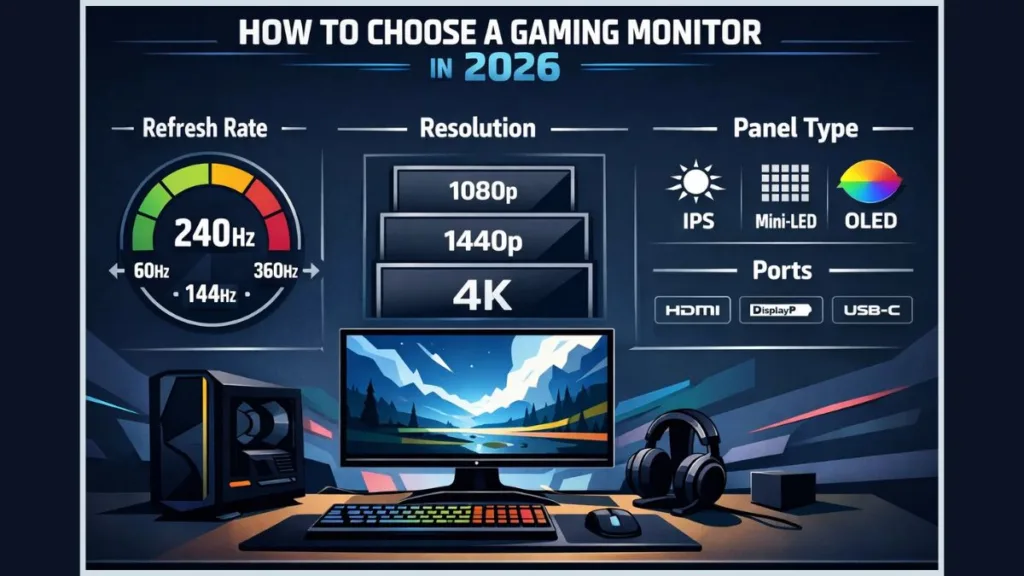
A high-refresh-rate monitor greatly enhances gaming immersion. Look for 144Hz or higher for smooth visuals. Response time matters, so aim for 1ms. Essential peripherals include a gaming mouse and a mechanical keyboard. These improve accuracy and responsiveness. Many pros use these items.
Ergonomics are also incredibly important for long sessions. Invest in a comfortable gaming chair. Position your monitor at eye level. Proper posture prevents fatigue and potential injuries. This ensures you can game comfortably for hours.
First Software Steps Drivers and OS
Once your PC is set up, install your operating system. Windows 11 is the current standard for gaming. Immediately update all your drivers. Graphics drivers from NVIDIA or AMD are critical. Chipset and audio drivers also need attention. Outdated drivers can cause FPS drop and stuttering fix issues. Keeping your drivers updated ensures optimal performance and stability. It prevents many common problems.
Optimizing Your Gaming Experience
Settings Optimization for Performance
Understanding in-game settings is key to great performance. Start with your monitor's native resolution. Adjust graphic quality settings like shadows and textures. Reducing these can significantly improve your FPS. Experiment to find a balance between visuals and frame rate. High FPS provides a smoother, more responsive experience. This is especially true for competitive titles.
Tackling Lag and Ping
Network performance impacts online gaming significantly. High ping or lag can ruin your experience. Always prefer a wired Ethernet connection over Wi-Fi. Close unnecessary background applications. These can consume bandwidth. Ensure your internet plan meets gaming demands. A fast, stable connection is vital for ranked play. This minimizes frustration during intense moments.
Exploring Game Genres and Communities
Popular PC Gaming Genres
The PC platform boasts an incredible variety of genres. FPS games like Valorant or Call of Duty are hugely popular. MOBA titles such as League of Legends demand strategic teamwork. RPGs like Cyberpunk 2077 offer immersive storytelling. Battle Royale games continue to dominate. Indie games provide unique, innovative experiences. Explore different types to find your niche. Don't be afraid to try something new.
Finding Your Community
PC gaming thrives on its vibrant communities. Join Discord servers for your favorite games. Participate in online forums and subreddits. Watch streamers and engage with their chats. Playing with friends enhances the fun. This social aspect is a core part of PC gaming. It's a great way to learn new strategies and tips. You'll meet like-minded players quickly.
Beginner / Core Concepts
- Q: I'm totally new to PC gaming. What's the absolute first thing I should consider before buying anything?
A: Hey there, I totally get why this feels like a giant leap! The absolute first thing you should consider is what types of games you *actually* want to play. Seriously, don't just jump for the most expensive rig. If you're into casual indie games or older RPGs, you won't need a top-tier powerhouse. But if you're eyeing the latest AAA titles at 4K or aiming for ranked pro play in a competitive FPS, then your budget and component choices will be very different. Knowing your game preference first helps you set a realistic budget and avoids overspending or underspending on your first PC build or pre-built system in 2026. It's all about matching the hardware to your personal gaming goals. You've got this, take your time! - Q: What's the difference between FPS (frames per second) and ping, and why do they matter for gaming?
A: This one used to trip me up too, so you're in good company! Basically, FPS measures how many distinct images your computer can display per second. Higher FPS means a smoother, more responsive visual experience, which is super critical for twitchy games like an FPS title. Ping, on the other hand, measures the time it takes for data to travel from your PC to a game server and back. Lower ping means less lag and quicker reactions in online games. For instance, in a MOBA or Battle Royale, high ping can be the difference between a clutch play and a frustrating defeat. Both are crucial for an enjoyable and competitive PC gaming experience, especially with the advanced graphics and online interactions of 2026 games. You're getting the hang of it already! - Q: Do I really need a "gaming" monitor, or can I just use my regular office monitor?
A: That's a super practical question, and I appreciate you thinking about it! You *can* absolutely start with a regular office monitor, especially if you're on a budget. However, you'll likely notice a significant upgrade if you eventually switch to a proper gaming monitor. Gaming monitors typically offer higher refresh rates (like 144Hz or 240Hz compared to 60Hz), lower response times (1ms vs. 5ms+), and technologies like FreeSync or G-Sync. These features drastically reduce screen tearing and input lag, providing a much smoother and more fluid visual experience. For a beginner, it's not a must-have, but it's definitely a worthwhile upgrade down the line, especially for fast-paced games. Give it a shot with what you have, and then see if you feel like you're missing out! - Q: How do I know if my PC build or pre-built system will be "future-proof" enough for games coming out in 2026 and beyond?
A: "Future-proof" is a tricky term in tech, isn't it? The honest truth is, true future-proofing is almost impossible due to how fast hardware evolves. However, you can make *smart choices* to extend your PC's relevancy. In 2026, look for a system with at least 16GB of DDR5 RAM, a robust CPU (like a mid-to-high tier i7 or Ryzen 7 from the current generation), and the most powerful GPU you can afford (e.g., an RTX 5070 or RX 8800 equivalent). Opt for a spacious NVMe SSD and a power supply with some headroom (e.g., 850W+). These choices give you a strong foundation and more upgrade paths for components like RAM or storage later on. It's about building a solid base, not predicting the impossible!
Intermediate / Practical & Production
- Q: My games are stuttering and my FPS drops randomly. What are the common culprits and how can I start troubleshooting?
A: Oh, the dreaded stuttering and FPS drop! I get why this is super frustrating. This usually points to a few common issues. First, ensure your graphics drivers are fully up to date; outdated drivers are a huge cause of performance hiccups. Next, check your PC's temperatures using monitoring software like MSI Afterburner or HWMonitor; overheating components will throttle performance. Background applications consuming resources can also be a culprit, so close anything unnecessary while gaming. Your RAM or VRAM might be capped, especially in graphically intensive games. Try reducing in-game settings like shadows or anti-aliasing. Also, verify your game files for corruption. Sometimes, a full reinstall of the game or even your GPU drivers (using DDU) can work wonders. Keep at it, you'll pinpoint it! - Q: What's the best way to optimize my in-game settings without sacrificing too much visual quality?
A: That's the eternal balancing act, isn't it? The best approach is often iterative. Start by setting your display resolution to your monitor's native resolution. Then, identify the most resource-intensive settings: usually shadows, anti-aliasing, global illumination, and texture quality. Begin by lowering these one by one or in small increments, checking your FPS after each change. Textures often have less impact on FPS than shadows, so you might keep them higher. Experiment with your visual settings to find a sweet spot where you maintain a stable, high FPS (e.g., above 60 or even 120 for competitive play) while still enjoying the game's aesthetics. Many games also offer pre-set graphics profiles like "High" or "Medium" which are great starting points. Remember, "good enough" visuals with smooth gameplay almost always beat "maxed out" stutter. You'll master it! - Q: I'm experiencing high ping and lag in online games. Is it my internet, or could it be something else with my PC?
A: High ping and lag are brutal, especially when you're trying to win a ranked match. While your internet connection is often the first suspect, it's not always the sole cause. Definitely start by ensuring you're using a wired Ethernet connection instead of Wi-Fi; Wi-Fi introduces latency and instability. Close all unnecessary background applications and browser tabs that might be consuming bandwidth. Run a speed test to check your actual internet speeds and compare them to your provider's advertised rates. If you're still seeing issues, check if your router's firmware is updated or if your ISP is experiencing outages in your area. On your PC, ensure no large downloads or updates are running silently. Sometimes, even firewall settings or VPNs can interfere. It’s a bit of detective work, but you'll get to the bottom of it! - Q: What are some crucial software tools or utilities every PC gamer should have installed in 2026?
A: Great question! Beyond your games themselves, a few essential tools can really enhance your PC gaming experience in 2026. First up, graphics driver software like NVIDIA GeForce Experience or AMD Adrenalin. These not only keep your drivers updated but often provide optimization features. Next, a system monitoring tool like HWMonitor or MSI Afterburner is vital for keeping an eye on CPU/GPU temperatures and usage. A good antivirus and antimalware solution is non-negotiable for security. For communication, Discord is practically standard for multiplayer. And finally, a robust backup solution, even just Windows Backup, to protect your game saves and important files. These tools make sure your rig runs smoothly and stays secure. Good choices here make a real difference! - Q: How do I keep my gaming PC clean, both physically and digitally, to maintain performance over time?
A: Excellent point about maintenance! This is often overlooked but crucial for longevity. Physically, you'll want to regularly clean dust from your PC case, fans, and heatsinks – at least every 3-6 months. Use compressed air, *not* a vacuum cleaner, and gently hold fans in place so they don't spin too fast. Digitally, make sure your operating system and drivers are always up to date. Periodically uninstall games and programs you no longer use to free up storage space. Run disk cleanup and defragment your hard drives (though not SSDs). A regular scan with your antivirus and antimalware software is also a must. Think of it like tuning up a car; a little consistent effort goes a long way in preventing future problems and maintaining peak performance. Keep that machine purring! - Q: What's the deal with "WASD" and why is it so fundamental to PC gaming?
A: Ha, the classic WASD! It really is the bedrock of PC gaming movement, isn't it? Basically, WASD refers to the four keys on the left side of a standard QWERTY keyboard: W for forward, A for left, S for backward, and D for right. It became the de facto standard because it keeps your left hand positioned perfectly to access other important keys nearby (like Shift for sprint, Ctrl for crouch, and number keys for weapons/abilities). This setup offers unparalleled ergonomic control and speed compared to arrow keys, especially in fast-paced genres like FPS or RPGs, allowing for fluid movement while your right hand handles aiming with the gaming mouse. It's a testament to good design that has stood the test of time, even into 2026. Once you get used to it, you'll wonder how you ever gamed without it!
Advanced / Research & Frontier 2026
- Q: With AI upscaling technologies like DLSS and FSR becoming standard, how should I adjust my expectations for future GPU purchases in 2026?
A: Ah, you're looking at the cutting edge, I love it! AI upscaling, like NVIDIA's DLSS and AMD's FSR, is indeed a game-changer. What this means for your future GPU purchases in 2026 is that you might not need to chase the absolute highest-end card to get excellent performance at high resolutions. These technologies effectively render games at a lower resolution and then intelligently upscale them using AI, resulting in near-native image quality with significantly higher FPS. This allows you to target a slightly less powerful (and often more affordable) GPU while still achieving premium visuals and frame rates, even at 4K. When evaluating GPUs, look at their tensor core count (for NVIDIA) or general AI acceleration capabilities (for AMD) as these are crucial for efficient upscaling. It really democratizes high-fidelity gaming! - Q: What are the considerations for someone looking to get into competitive or "ranked" PC gaming in 2026?
A: So you're ready to dive into the competitive arena – that's awesome! Ranked PC gaming in 2026 demands a few key considerations. First, your hardware needs to be rock-solid: a high-refresh-rate monitor (144Hz+), a low-latency gaming mouse, and a responsive mechanical keyboard are almost mandatory. Second, a stable, low-ping internet connection (wired Ethernet is non-negotiable) is vital to avoid lag. Beyond hardware, invest in game knowledge: study maps, learn character abilities, and understand meta strategies. VOD review (watching replays of your own gameplay) is crucial for identifying mistakes. And perhaps most importantly, cultivate mental resilience; ranked play is tough, and learning from losses is key. Join a team or find consistent teammates to practice with. It's a journey, but a rewarding one! - Q: How can I get started with game streaming or content creation while also maintaining a good gaming experience on my single PC setup?
A: This is a fantastic goal, and totally achievable on a single PC, though it requires smart optimization! The biggest challenge is CPU utilization, as both gaming and encoding video are demanding. First, ensure your CPU has plenty of cores/threads (e.g., an Intel i7/i9 or AMD Ryzen 7/9). For streaming, leverage your GPU's dedicated encoder (NVIDIA NVENC or AMD AMF/VCE); these offload encoding from your CPU, significantly reducing performance impact. Use streaming software like OBS Studio and optimize its settings – start with a lower bitrate and resolution, then gradually increase. Close all non-essential background programs. In 2026, some GPUs even feature specific streaming optimizations, so check your card's capabilities. It's a balancing act, but with the right settings, you can absolutely game and stream beautifully. Good luck, future content creator! - Q: What are the current trends in ergonomic peripherals (keyboards, mice, chairs) in 2026 that I should be aware of for long gaming sessions?
A: You're smart to focus on ergonomics; your body will thank you later! In 2026, the trend in ergonomic peripherals is all about micro-adjustments and personalized fit. For mechanical keyboards, we're seeing more split designs, tenting options, and even fully customizable layouts to reduce wrist strain. Mice are evolving with adaptive grips, adjustable weights, and even modular components to fit different hand sizes and grip styles perfectly. Wireless technology has advanced to near-zero latency, making ergonomic wireless options very viable. Gaming chairs are moving beyond just "racing style" to truly ergonomic designs with lumbar support that adapts to your spine's natural curve, and even materials that regulate temperature. Don't cheap out here; comfort directly impacts performance and prevents long-term health issues. Your future self will appreciate the investment! - Q: With the rise of cloud gaming services, is building a high-end gaming PC still necessary for someone just starting out in 2026?
A: That's a super insightful question about the evolving landscape! Cloud gaming services like GeForce NOW or Xbox Cloud Gaming have indeed come a long way by 2026, offering impressive experiences with just a good internet connection. For someone *just starting out* with a limited budget and wanting immediate access to a vast library of games without hardware worries, cloud gaming is a perfectly valid and increasingly compelling option. However, building a high-end gaming PC still offers distinct advantages: no input lag (critical for competitive play), superior visual fidelity (especially if you have a top-tier monitor), the ability to play any game you own without subscription restrictions, modding capabilities, and the satisfaction of owning your hardware. So, while not *strictly necessary* for *everyone* anymore, a dedicated PC still provides the ultimate, uncompromised gaming experience. It really depends on your priorities and budget.
Quick 2026 Human-Friendly Cheat-Sheet for This Topic
- Know Your Games: Before buying, decide what genres (FPS, MOBA, RPG) you want to play. This guides your budget!
- Wired is Best: Always use an Ethernet cable for online gaming to slash ping and lag.
- Update Your Drivers: Keep your graphics drivers fresh; it’s the quickest performance boost.
- Monitor Your Temps: Overheating can cause FPS drops and stuttering; use monitoring software.
- Balance Settings: Don't chase max graphics; find the sweet spot for smooth FPS and good visuals.
- Ergonomics First: Invest in a good chair, mechanical keyboard, and gaming mouse for comfort and health.
- Community Up: Join Discord servers and forums to connect, learn, and find teammates.
Essential PC setup, optimizing game performance, understanding gaming peripherals, troubleshooting common issues like lag and FPS drops, exploring popular game genres, future-proofing your gaming rig.
35


Top 10 Most Anticipated Games Of 2026 What To Watch Out For GAMES IN 2026 . Mi PC Gaming 2026 PlayStation Pro Switch 2 Y Una RTX 5090 En Un Solo . How To Choose A Gaming Monitor In 2026 Complete Gaming Monitor Buying Gaming Monitor Guide 2026. How To Build A Future Proof Gaming PC A Step By Step Guide 2025 Future Gaming Pc Build 2025.webp. Complete Beginner S Guide To PC Gaming Best Gaming Setup 2025 768x439




Come Assemblare Un PC Guida Per 2026 Best Mini PCs For Gaming.webp. TOP 50 BIGGEST NEW Games Coming In 2026 With Crazy NEXT GEN 4K Graphics . How To Upgrade Your Gaming PC 2026 Edition GadgetMates Bg Intro1 . TOP 40 BIGGEST NEW Games Coming In 2026 With Crazy NEXT GEN 4K Graphics . TOP 10 BEST NEW Upcoming Games Of 2026 YouTube


Top 10 Most Anticipated Games Of 2026 Biggest Upcoming Game Releases . Microsoft Brings AI Powered Assistance To Gaming Copilot Gaming Beta . AMD Chinese Firm Develop 1000Hz Gaming Monitor 2026 Release World . 3 Best Prebuilt Gaming PCs Of 2026 Power Up Your Gameplay Top 2025 Gaming Pc Picks 2g35l . Alienware Aurora Gaming PC With RTX 5060 Ti Is The Perfect Deal To Alienware Aurora Gaming PC With RTX 5060 Ti Is The Perfect Deal To Start Off 2026


The Best Cheap Gaming Laptops For 2026 Tested For Gaming Top 3 Gaming Laptops Of 2026 - The Ultimate Guide 1200x342 . How To Build A Gaming PC In 2023 Complete Checklist TCG Best Gaming PC Build In 2023 1536x864 . Important Info About Getting Started With The Crystal Super Pimax Store Tai Bui Q XGz9NOVOE Unsplash . The Game Awards Start Time Countdown Clock Where To Watch And A List Intel At CES 2026 Panther Lake Laptop Gaming . Best Gaming Laptops PCs For Battlefield 6 RedSec In 2025 Best Gaming Desktop PC 2025 Main

Building A New Gaming PC In 2024 FullCleared Building A Gaming Pc In 2024 Fullcleared 35 . LEAKED Xbox Prime Next Generation Console For 2026 Xbox Developer . Summer Game Fest 2026 Eurogamer Net Sgf26 1920x1080 . NVIDIA Pushes GeForce Now India Launch To Q1 2026 But The Wait Will Be . If GTA 6 Isn T Coming To PC Until 2026 This Is What A Top End Gaming 1200 80



Best Gaming PC Of 2024 For Every Budget YouTube . Best Gaming PCs To Buy In 2024 8ca85 1920 . How To Configure IP Addresses IDatam Best Gaming Servers 2026.webp. Xbox Game Pass In 2026 The Full List Of Everything Announced So Far Xbox Game Pass In 2026 The Full List Of Everything Announced So Far.900x . What To Read In 2026 EMSEKFLOL COM Thumb2 3d 2026 Digits 4k 2026 Concepts Red Technology Background 2026 New Year


Best PC Games 2025 2026 And What To Expect In 2026 New Games 2025 2026 . Vs Pangoly Vs BuildMyPC Which Is The Best PC Building Tool Building A Gaming PC In 2026.webp. PC Gaming Show Returns June 8 Here S When And How To Watch The Show . How To Build A Budget Gaming PC In 2024 Detailed Guide How To Build A Budget Gaming PC 1024x576 . The Best Workout Apps To Start Your 2026 Off Right Stuff Best Gaming Consoles Hero Image